










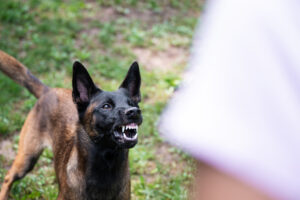
Americans own roughly 90 million dogs, and dogs live in close to half of all U.S. households. Most of those dogs never hurt anyone. But the Centers for Disease Control and Prevention estimates that dogs bite about 4.5 million people in the United States every year, and nearly 900,000 of those victims need medical care. In 2022 alone, dog bite injuries sent more than 395,000 people to emergency rooms. The financial toll is climbing as well: insurers paid out more than $1.5 billion on dog-related injury claims in 2024, with the average claim approaching $70,000.
Many people assume that when a dog bites, the owner automatically pays. Nevada law says otherwise. Whether a victim can recover compensation depends on whether the owner acted negligently. This article explains how that standard works, which statutes and ordinances matter, and why acting quickly after an attack can make or break a claim.
Nevada Rejected the “One Bite Rule” — But It Is Not a Strict Liability State Either
Many states follow some version of the “One Bite Rule,” under which an owner is liable only if he or she knew, or should have known, that the animal had dangerous or vicious propensities. Others impose strict liability, holding the owner responsible for a bite regardless of the dog’s history or the owner’s care.
Nevada follows neither approach. In Glass v. Eighth Judicial District Court, 87 Nev. 321 (1971), the Supreme Court of Nevada rejected the notion that a dog is entitled to one free bite. At the same time, the Nevada Legislature has never enacted a statute imposing automatic civil liability on dog owners. Instead, dog bite cases in Nevada are decided under ordinary negligence principles: did the owner (or the person in custody of the animal) exercise the level of care that a reasonably prudent person would have exercised under similar circumstances?
That question turns on the facts of each case. Among the issues we investigate:
- Where did the bite occur, and did the victim have a right to be there?
- Was the dog provoked?
- Was the dog leashed, fenced, or otherwise restrained?
- Did the dog have a history of aggressive or nervous behavior, and did the owner know about it?
- How was the dog trained, socialized, and cared for?
- Did the owner violate any statute or ordinance governing the animal?
One more point deserves emphasis. Regardless of breed, the law presumes all dogs are tame and harmless absent evidence to the contrary. See, e.g., Goennenwein v. Rasof, 695 N.E.2d 541, 544 (Ill. App. Ct. 1998). The victim therefore carries the burden of proving the dog’s dangerous nature or the owner’s substandard conduct. Meeting that burden frequently requires substantial discovery — animal control records, veterinary records, witness statements — and, in serious cases, expert testimony on canine aggression and behavior.
Negligence Per Se: When a Violation of Law Establishes Fault
Negligence may also be established by proving the owner violated a law designed to protect the public. This doctrine is called negligence per se. Where it applies, the victim does not need to prove that a reasonable person would have acted differently. The violation itself establishes the breach, and the case turns on whether that violation caused the injuries.
Two Nevada statutes are frequently relevant.
NRS 575.020 makes it a misdemeanor for any person having care or custody of an animal known to possess vicious or dangerous tendencies to allow it to escape or run at large in a manner liable to endanger the safety of any person.
NRS 202.500 governs “dangerous” and “vicious” dogs statewide. A dog may be declared dangerous if, without provocation, it twice within 18 months behaves menacingly enough that a reasonable person would defend against substantial bodily harm. A dog is vicious if, without provocation, it kills or inflicts substantial bodily harm on a person, or if it continues dangerous behavior after the owner has been formally notified of a dangerous-dog declaration. Knowingly keeping or transferring a vicious dog is a crime, and further attacks can expose the owner to felony liability. Notably, the statute prohibits declaring a dog dangerous or vicious based solely on its breed; Nevada law focuses on the individual animal’s behavior. A prior dangerous-dog declaration is powerful evidence that an owner knew of the risk and failed to act on it.
Local Leash and Restraint Ordinances
Every city and county in Nevada also regulates the ownership and restraint of animals, and violations of those ordinances can support negligence per se.
In Clark County, Ordinance 10.36.040 prohibits an owner or custodian from allowing any animal (other than a cat) to stray or run at large. Ordinance 10.04.100 defines “at large” broadly. An animal is at large if it is unrestrained on property where it is not permitted, restrained only by voice command, or unrestrained in privately owned areas open to the public, such as store entrances or the common areas of an HOA community. A dog is not at large when it is confined in a house, vehicle, or adequately fenced yard, or inside a properly fenced and posted dog run at a park. Clark County Ordinance 10.16.010 sets out the county’s own procedures for declaring an animal dangerous or vicious, with exceptions for provocation, trespassers, and law enforcement animals, and Ordinance 10.16.020 makes it unlawful to possess or transfer a dangerous or vicious animal in unincorporated Clark County except as the chapter allows.
In the City of Las Vegas, Municipal Code 7.36.030 makes it unlawful for an owner or custodian to allow an animal to be at large, and Code 7.04.090 defines an animal as at large unless it is secured by a leash or lead or confined to the owner’s property by a fence, cage, chain, or other restraining device.
In Washoe County, Ordinance 55.100 imposes an absolute duty in the county’s congested areas to keep dogs and other listed animals restrained on the owner’s premises, and requires dogs in public parks to be leashed. Outside those congested areas, the duty is less clearly defined.
The practical consequence: a bite under identical circumstances might create clear owner liability in Las Vegas but a much harder case in a rural stretch of Washoe County. Which ordinance applies, and whether it was violated, is one of the first questions a knowledgeable attorney will answer.
What If the Victim Was Partly at Fault?
Owners and insurers frequently argue that the victim provoked the dog, ignored warnings, or trespassed. Nevada applies modified comparative negligence under NRS 41.141. A victim who is partly at fault can still recover, with the award reduced by his or her percentage of fault, so long as the victim’s fault does not exceed that of the defendant. Provocation is also a defense to a dangerous or vicious declaration under both state law and the Clark County code. These issues are fact-intensive, which is another reason witness statements and physical evidence should be preserved immediately.
Landlord Liability for a Tenant’s Dog
Victims sometimes ask whether the landlord of the dog’s owner can be held responsible. The answer under Nevada law is: not merely because of the landlord’s status, but possibly because of the landlord’s conduct.
In Wright v. Schum, 105 Nev. 611, 781 P.2d 1142 (1989), a passerby bitten by a tenant’s dog sued the landlord. The Nevada Supreme Court held that a landlord has no duty to protect third parties from a tenant’s dog based on the landlord relationship alone. But a landlord may assume such a duty through his or her own actions. In Wright, the landlord had allowed the tenant to remain on the property only on the condition that the dog stay inside or chained, and had failed to repair a broken front gate that let the dog escape. Those facts were enough to expose the landlord to potential liability.
Courts have declined to go further. Landlords are generally not required to investigate the history of a tenant’s dog, and a lease provision permitting a dog is not treated as the landlord’s endorsement of a dangerous animal. See Georgianna v. Gizzy, 483 N.Y.S.2d 892, 894 (N.Y. Sup. Ct. 1984); Robison v. Stokes, 882 P.2d 1105, 1106 (Okla. Civ. App. 1994).
Compensation and the Deadline to File
A dog bite victim who establishes liability may recover medical expenses (including future reconstructive or scar-revision surgery), lost income, and compensation for pain, disfigurement, and emotional harm. Children are especially vulnerable; bites to the face and hands often leave permanent scarring, and the psychological effects can outlast the physical wounds.
Nevada generally allows two years from the date of injury to file a personal injury lawsuit. Claims involving minors or government-owned animals follow different rules. Do not assume you have time to spare.
What to Do After a Dog Bite
The strength of a dog bite claim often depends on evidence that disappears within days:
- Seek medical care immediately, and photograph the injuries before and during treatment.
- Identify the dog and its owner, and confirm the dog’s vaccination status.
- Report the attack to animal control. The resulting investigation may document the dog’s history and living conditions.
- Get names and contact information for every witness.
- Photograph the scene, including any broken fences, open gates, or missing signage.
- Do not give a recorded statement to the owner’s insurer before speaking with an attorney.
Speak With a Las Vegas Dog Bite Attorney — Free of Charge
The fact that a bite occurred does not by itself establish liability in Nevada. The victim must prove that the owner or caretaker violated the law or otherwise acted unreasonably. Building that proof takes prompt investigation, knowledge of the overlapping state statutes and local ordinances, and, in serious cases, qualified experts.
If you or a loved one has been injured in a dog attack, contact the Las Vegas personal injury attorneys at Shook & Stone for a free consultation at (702) 356-0582. Time matters. Living conditions change, witnesses scatter, and animal control records grow stale. Let us move quickly to protect your rights.
 DIRECTIONS