
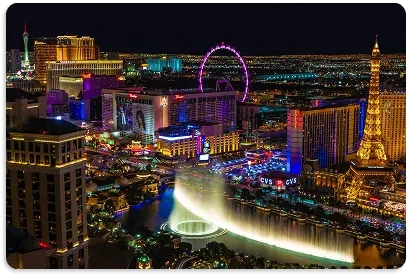




Waymo started running cars with nobody in the driver’s seat here this summer. Its own employees get the first rides, with public service to follow. Zoox has been hauling riders around the Strip in shuttles that don’t even have a steering wheel, and federal regulators just cleared the company to start charging fares. The Raiders went ahead and made Waymo the official ride-hailing partner of Allegiant Stadium. Whatever you think of the technology, it is now part of Las Vegas traffic, and this city will see its first serious robotaxi injury cases soon.
Most rides end without incident. The record so far still deserves a hard look.
The Glitches Are Piling Up
The New York Times reported in August that Waymo has issued three federal recalls since December, matching its total for the previous 22 months. Its cars drove into flooded roads. One carried passengers through an active highway construction zone at speed while highway patrol officers shouted at it to stop. On the Fourth of July in San Francisco, stalled Waymos jammed the waterfront for hours, and one drove over an exploding firework with two riders inside, then kept going.

In July the head of the National Highway Traffic Safety Administration wrote that his agency had identified a clear pattern of autonomous vehicles interfering with police, firefighters, and paramedics. A Carnegie Mellon professor who studies these systems explained why: the software has trouble recognizing when it faces a situation it was never trained on, and in those moments it tends to plow ahead anyway. Engineers call these edge cases. On an actual street, an edge case looks like a pedestrian, a work crew, or a crowd leaving a stadium.

Las Vegas has already had collisions. In a recent crash on Polaris Avenue, an SUV driver lost control and hit an unoccupied Waymo, according to the company. Zoox recalled software last year after one of its empty shuttles got into a Las Vegas collision. Thousands more of these vehicles are on the way.
Without a Driver, the Defendant Is Often the Product
Free Consultation We’ll help you win the benefits you need to get your life back.
An ordinary crash case starts with the driver. Did he run the light, follow too closely, look down at a phone? A robotaxi case has no driver to depose. Software made the driving decisions, using cameras, radar, and laser sensors, all of it designed, tested, and updated by corporations. So the injured person’s claim frequently runs against the product itself, with negligence claims layered on against other companies in the chain.
Which theory fits which company matters. Strict product liability reaches the businesses in the product’s chain: the vehicle manufacturer, the developer of the driving system, the maker of a failed component. A company that merely maintained, dispatched, or monitored the vehicle usually has to be pursued in negligence instead. The Nevada Supreme Court addressed this line in 2025 in Hernandez v. The Home Depot. A company that did nothing beyond licensing its brand name escapes strict liability; a company that substantially participated in the design, manufacture, or distribution of the product does not. Figuring out which company controlled the function that failed is the first job in any of these cases.
Nevada’s Strict Liability Rules
Nevada adopted strict product liability in 1966, in Shoshone Coca-Cola Bottling Co. v. Dolinski. An injured person doesn’t have to prove the manufacturer was careless. She has to show the product left the company’s hands with a defect, that she was using it in a reasonably foreseeable way, and that the defect caused her injury.
Nevada also measures defects by the consumer expectation test, which the state supreme court reaffirmed in Ford Motor Co. v. Trejo in 2017. A design is defective if the product fails to perform as safely as an ordinary consumer would expect. The court refused to make injured plaintiffs prove a safer alternative design as part of their case, though that kind of engineering proof can still help.
Apply that test to a robotaxi. An ordinary rider expects the car to stop for obstacles and stay out of a flooded street. A pedestrian expects it to see her in the crosswalk. A jury asked whether a car that drove through a coned-off construction zone performed as safely as an ordinary consumer would expect will not have a hard question in front of it.
Two Nevada Statutes Govern Robotaxis
Nevada authorized autonomous vehicles before any other state, back in 2011. Two chapters of the Nevada Revised Statutes now apply.
Chapter 482A covers the vehicles. It defines an automated driving system by reference to the Society of Automotive Engineers standard, an autonomous vehicle as one designed to operate at Level 3, 4, or 5, and a fully autonomous vehicle as one built for Levels 4 or 5, where no human is expected to take over (NRS 482A.025, .030, .036). A company has to post five million dollars in insurance or equivalent security before it tests autonomous vehicles on Nevada highways (NRS 482A.060). A fully autonomous vehicle can run empty only if it can bring itself to a safe stop when the system fails (NRS 482A.070, .080). Testing crashes with injuries or significant property damage have to be reported to the Nevada Department of Motor Vehicles within ten business days (NRS 482A.095).
Chapter 706B covers selling rides. A company connecting paying passengers to fully autonomous vehicles needs a permit from the Nevada Transportation Authority before doing business in the state (NRS 706B.110). With the permit comes the right to charge fares (NRS 706B.160) and a set of duties: inspect every vehicle before service and annually after that (NRS 706B.170), report crashes that happen during transportation services (NRS 706B.260), and carry at least 1.5 million dollars in coverage for injury or death in a crash occurring between the moment the company accepts a ride request and the moment the passengers fully leave the vehicle (NRS 706B.300, 706B.050).
So one of the first facts to nail down after a crash is what the vehicle was doing. A car in testing, a car deadheading between fares, and a car carrying a paying passenger each sit under different requirements.
One more provision affects the defendant list. Under NRS 482A.090, the original manufacturer generally isn’t liable for a defect caused by someone else’s later conversion or modification of the vehicle or its driving system. The protection falls away if the defect was present in the original product. Every one of these cases will therefore involve a fight over the software history and who last controlled the system.
Fault and Damages Work Differently in Product Cases
In a negligence claim, Nevada’s comparative fault statute reduces a partly-at-fault plaintiff’s award by her percentage, and bars recovery entirely if her share of fault exceeds the defendants’ (NRS 41.141). Strict product liability works differently. The Nevada Supreme Court held in Young’s Machine Co. v. Long in 1984 that comparative negligence is no defense to a strict liability claim, so ordinary carelessness by the injured person doesn’t trim the recovery. The manufacturer is left with narrower defenses: that the plaintiff knowingly and voluntarily took on the specific risk, that the product was misused in an unforeseeable way, or that a substantial alteration caused the injury.
Allocation among defendants differs too. Negligent defendants generally pay only their own percentage of a judgment, but the statute preserves whatever joint and several liability otherwise exists in strict liability and product actions (NRS 41.141(4), (5)). Whether a given company can be made to pay the whole judgment depends on its role and on the claims proved against it.
Punitive damages follow their own rule. Nevada caps punitive awards in most cases, but the cap does not apply to an action against a manufacturer, distributor, or seller of a defective product (NRS 42.005(2)(a)). The injured person still has to prove oppression, fraud, or malice by clear and convincing evidence, and the exception won’t cover every company tied to the vehicle. For a manufacturer that knew about a defect and left its fleet on the road, though, there is no ceiling.
The Evidence Sits on Their Servers
A robotaxi records almost everything: camera footage, lidar and radar returns, telemetry, software versions, remote-operator sessions, internal incident reviews. Federal rules require companies to report certain automated driving crashes to the National Highway Traffic Safety Administration, and Nevada requires a permitted operator to keep trip records, inspection records, complaints, and crash reports for at least three years (NRS 706B.220). Notice what that retention rule leaves out: the raw sensor logs and onboard video showing what the system actually saw and decided. That data lives on company servers, in formats only the company can read, and routine operations can overwrite it.
Step one in these cases is a preservation demand on every company in the chain, covering the statutory records and the raw data underneath them. Nevada gives an injured person two years to file a personal injury or wrongful death suit (NRS 11.190(4)(e)). The data that decides the case can be gone in weeks.
Keep in mind that plenty of robotaxi crashes will turn out to be ordinary negligence cases. Human drivers still cause most collisions, including the Polaris Avenue crash. A real investigation runs down all of it: the driving system, the operator’s inspections and oversight, the component suppliers, the maintenance shops, and the humans on the road.
Talk to Us Before the Companies Finish Their Version
Shook & Stone has represented injured Nevadans for more than 25 years. If a Waymo, a Zoox, or any autonomous vehicle was involved in your crash, whether you were riding in it, driving near it, biking, or walking, understand that the operator’s lawyers and engineers started working on the incident within hours. Your side deserves the same head start.
The consultation is free, and you pay nothing unless we recover for you. Call Shook & Stone or reach us online today.


 DIRECTIONS